Unreal Engine pluginVersion 1.0.0

Collision,where youpaint it.

Collider Painter is a collision authoring toolset for Unreal Engine. Paint the parts of a mesh that need collision, fit or decompose each one, bake native collision, then measure how closely it follows the surface.

Coming soon on Fab Watch the trailer Documentation
Fig. 01  The trailer. Every shot is recorded in the Unreal Editor.01:39
Engine
Unreal Engine 5.5 – 5.8
Platforms
Windows · macOS · Linux · Android · iOS · Consoles
Works with
Blueprint · C++ · Python
Tested
173 automated tests on every engine version

01  Why it existsOne hull is not a shape

Automatic collision treats a mesh as one problem. Collider Painter lets you say which parts matter, then proves the result in the viewport and in numbers.

Before A mug with one convex hull drawn over it; the hull spans the opening and fills the handle, and a ball sits beside it.
One hullOne convex hull around a mug closes the cup and fills the handle’s loop: a ball rests on an invisible lid and a rod stops in the handle.
After The same mug after painting two hulls: the ball is inside the cup and a rod passes through the handle.
Two painted hullsPaint the cup and the handle as two hulls and each is fitted or decomposed on its own. The same ball drops into the cup and the rod passes through the handle.

02  How it worksOne editor window

Paint. Fit.Bake. Check.

The whole loop runs in one editor window, and every step can be undone.

  1. 01

    Paint

    Add a hull and paint the triangles it should cover. A Ctrl+click floods a whole smooth part, inside and out; material slots, UV islands and polygroups select in one click too.

    BShiftCtrl
  2. 02

    Fit

    Choose Box, Sphere, Capsule, Cylinder or Convex and fit it to exactly the painted triangles, or decompose a concave part. Live Fit updates the shape while you paint.

    XY
  3. 03

    Bake

    Bake writes Unreal’s own simple collision. Collision you made by hand is kept unless you choose Replace All Collision. Save the mesh to keep it.

    CtrlShiftB
  4. 04

    Check

    QA samples the distance between the collision and the render surface and colours it on the mesh, with walkable faces and overlapping pairs.

    CtrlShiftQ

Follow the Quickstart: your first collision in five minutes

03  What it coversSeven recordings from the editor

Built forwhat you ship.

Fig. 02  Static MeshesPainting hulls →

04  QADrag to compare

Measured,not eyeballed.

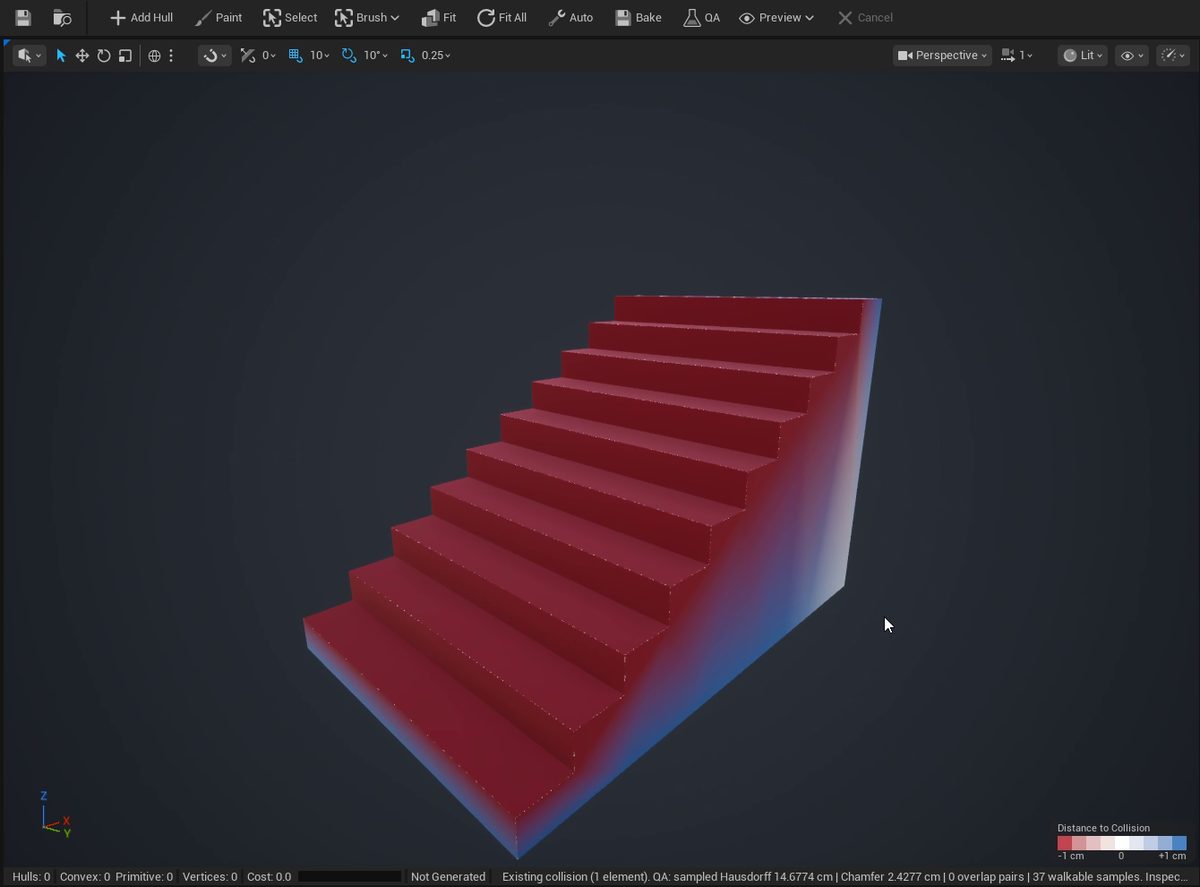
QA colours the distance on the mesh: red where collision sticks out, blue where it falls short.
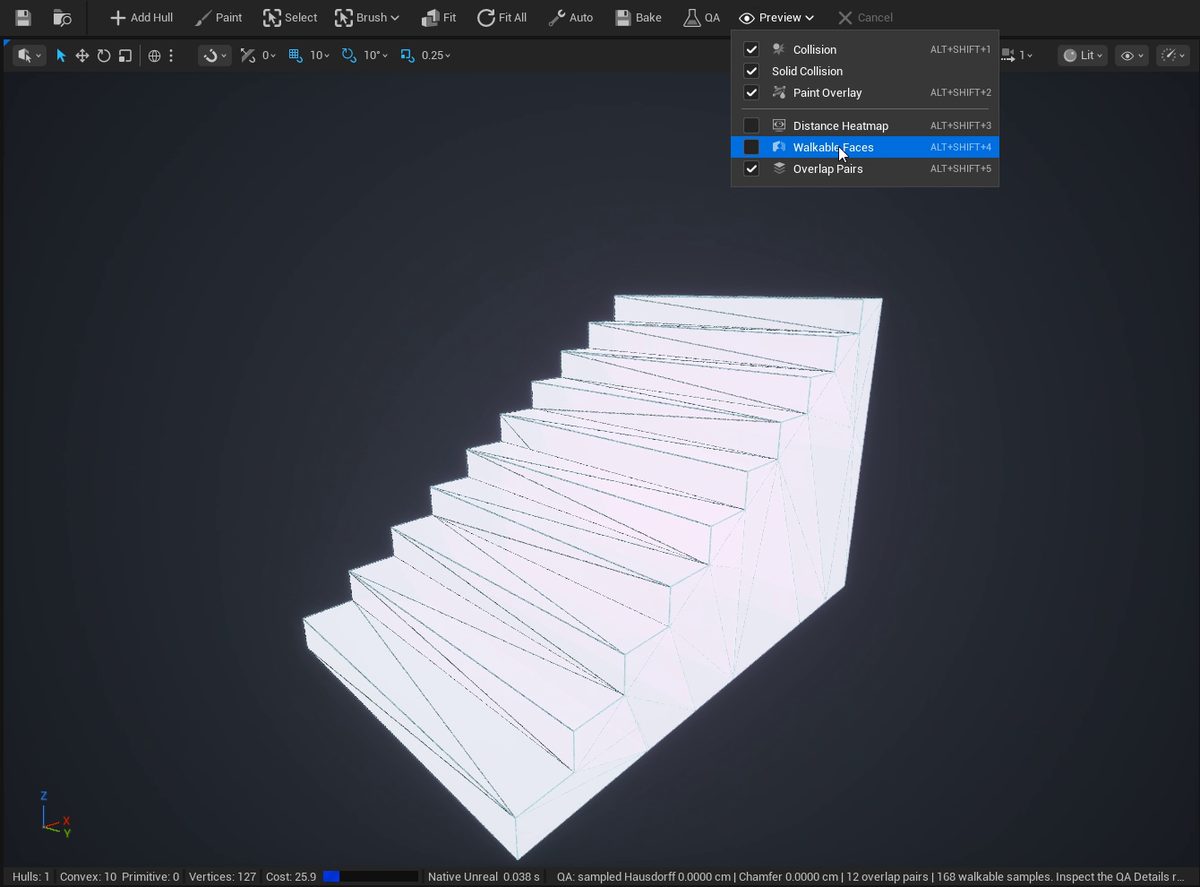
After: ten convex elements follow the steps of the staircase and the heatmap is white. Before: the staircase's existing collision is one convex and the heatmap colours the steps red. BeforeAfter
Before
14.68cm

A staircase’s existing collision, one convex. Sampled Hausdorff distance.

After
0.00cm

Protect Walkable Clearance and Auto: ten convex elements that follow the steps.

Distances are sampled at render vertices. They tell you where to look; they are not a continuous guarantee. QA also measures collision you already have, before you change anything.

05  FeaturesStatic, skeletal, fractured, runtime

Every kindof collision.

Paint and select

Select a part in one click

Brush with radius and falloff, erase, flood by normal angle, connected regions, material slots, UV islands, polygroups, box, lasso and mirror symmetry.

Painting hulls

Fit primitives

Boxes where boxes fit

Box, sphere, capsule, cylinder or convex hull, fitted to exactly the painted triangles, with Live Fit while you paint.

Fitting

Auto decomposition

Three solvers on the CPU

CoACD, Unreal’s native decomposition and primitive subdivision, with Draft, Balanced and Precise presets. Optional CuACD on NVIDIA GPUs.

Decomposition
The Skeleton Tree lists each bone with its joint type beside a character covered by 22 generated bodies.

Characters and ragdolls

A Physics Asset that is meant to ragdoll

For rigs the names do not explain, bone rules say what each bone is. Save them in a Skeleton Profile and every character on that rig generates the same way.

BoneJointSwing 1Swing 2Twist
Calf, shinHinge0–140lockedlocked
ForearmHinge0–145lockedlocked
ThighBall603025
Upper armBall806040
SpineCone151515
Characters and ragdolls
Chaos's collision view of two fractured mugs: default hulls on the left, per-piece hulls on the right.

Geometry Collections

Collision that follows every piece

Left: the default per-piece hulls fill the handle’s loop. Right: after Generate All Pieces, the hulls follow each piece.

Geometry Collections
The Collision Recipe Results window: three meshes succeeded, with element and vertex counts and times.

Recipes and batch

Collision for a whole folder

Prop, Vehicle, Building, VR Grabbable, Walkable, or your own recipe asset. The CPApplyRecipe commandlet runs the same recipes from a build script.

Collision Recipes

Bake, import, export

Native collision, nothing extra at runtime

Import UCX_, UBX_, USP_ and UCP_ collision from FBX or OBJ, and export to FBX.

Bake

Scripting

Blueprint, Python and a commandlet

The editor and runtime features are exposed to Blueprint and Python, and console commands drive the editor. Your painted regions stay editable as editor-only data and are stripped when the game is cooked.

Scripting and API reference

06  RuntimeA live Blueprint graph

Collision formeshes builtduring play.

Generate Collision Async

The node copies a Dynamic Mesh, Procedural Mesh or runtime Static Mesh on the game thread, solves on a worker and applies native collision before On Complete fires.

The graph is live: drag to pan, scroll to zoom. Copy Blueprint puts the nodes on your clipboard so you can paste them into a Blueprint whose parent class is Dynamic Mesh Actor.

Runtime module

Paste into a Blueprint whose parent class is Dynamic Mesh Actor.
Full screen

07  RequirementsVersion 1.0.0

What you need.

Unreal Engine
5.5, 5.6, 5.7 and 5.8, from the launcher. No engine source build is needed.
Platforms
Windows · macOS · Linux · Android · iOS · Consoles
Editor tools
Windows, macOS and Linux editors.
Plugin type
Code plugin with C++ source: CPU solver, geometry core, runtime, editor, optional GPU loader and tests.
Blueprint
Generate Collision Async, Generate Collision (Blocking), skeletal, Geometry Collection and recipe functions.
Python
Editor scripting library and runtime collision jobs.
Dependencies
None for CPU use. Procedural Mesh support uses Unreal’s optional ProceduralMeshComponent plugin. GPU acceleration is optional: a separately built CuACD library for NVIDIA GPUs, editor only, Windows and Linux.
Test evidence
What was built and what was run on each platform is listed on the Compatibility page of the documentation.
Support
amrothabetfab@gmail.com, or the Support page.

08  QuestionsBefore you buy

Questions,answered.

Will it overwrite collision I made by hand?
No. A normal bake replaces only the collision Collider Painter made before and keeps every other shape. Replace All Collision is an explicit option, and the Content Browser’s option switches itself off after each run.
Does my packaged game need anything from the plugin?
Not for baked collision. Bake writes Unreal’s native simple collision, and the painted regions are editor-only data that is stripped when the game is cooked. You only need the plugin’s runtime module if you generate collision while the game runs.
Do I need an NVIDIA GPU or CUDA?
No. Every solver runs on the CPU. CuACD GPU acceleration is an optional, separately built library for the editor; when it is not available, Turbo falls back to CPU CoACD and says so.
Can I generate collision while the game is running?
Yes, for Dynamic Mesh Components, Procedural Mesh Components and Static Meshes created at runtime with CPU-readable data. The solver runs on a worker thread; applying the collision happens on the game thread, so very large meshes can still cause a short stall. Content assets should be baked in the editor instead.
Does it work with characters and ragdolls?
Yes. Generate Character creates bodies and joints on a Physics Asset, keeps bodies and joints that already exist, and limits new joints by bone type. Bone rules and Skeleton Profiles cover rigs whose bone names are not standard.
Can I process a whole project?
Yes. Apply a recipe to a Content Browser selection, or run the CPApplyRecipe commandlet with -DryRun first to get a CSV report without changing anything.
What about very dense or Nanite meshes?
By default, when a mesh’s source geometry exceeds 200,000 triangles, authoring uses the engine-built Nanite fallback mesh instead. The threshold and the source are settings.
Is it a remesher for broken scans?
No. Its cleanup welds vertices, removes bad faces and closes simple holes. Complex scans may need remeshing in another tool first. See Known limitations.

09  ChangelogFull changelog

1.0.0First version

  • Static Mesh, Skeletal Mesh and Geometry Collection collision editors, and a Collider Painter mode in the Level Editor.
  • CPU decomposition with CoACD, Native Unreal and Primitives backends; optional CuACD GPU acceleration in the editor.
  • Character generation with joint limits by bone type, bone rules and Skeleton Profiles.
  • Collision recipes, batch apply, the CPApplyRecipe commandlet, and FBX/OBJ collision import and FBX export.
  • Runtime generation for Dynamic Mesh, Procedural Mesh and transient Static Mesh targets.

Collider Painter · Version 1.0.0

Paint thecollisionyou meant.

Unreal Engine 5.5 – 5.8. Full documentation, from the first hull to runtime generation. Price and licence terms on Fab.

Coming soon on FabQuickstartAsk a question